

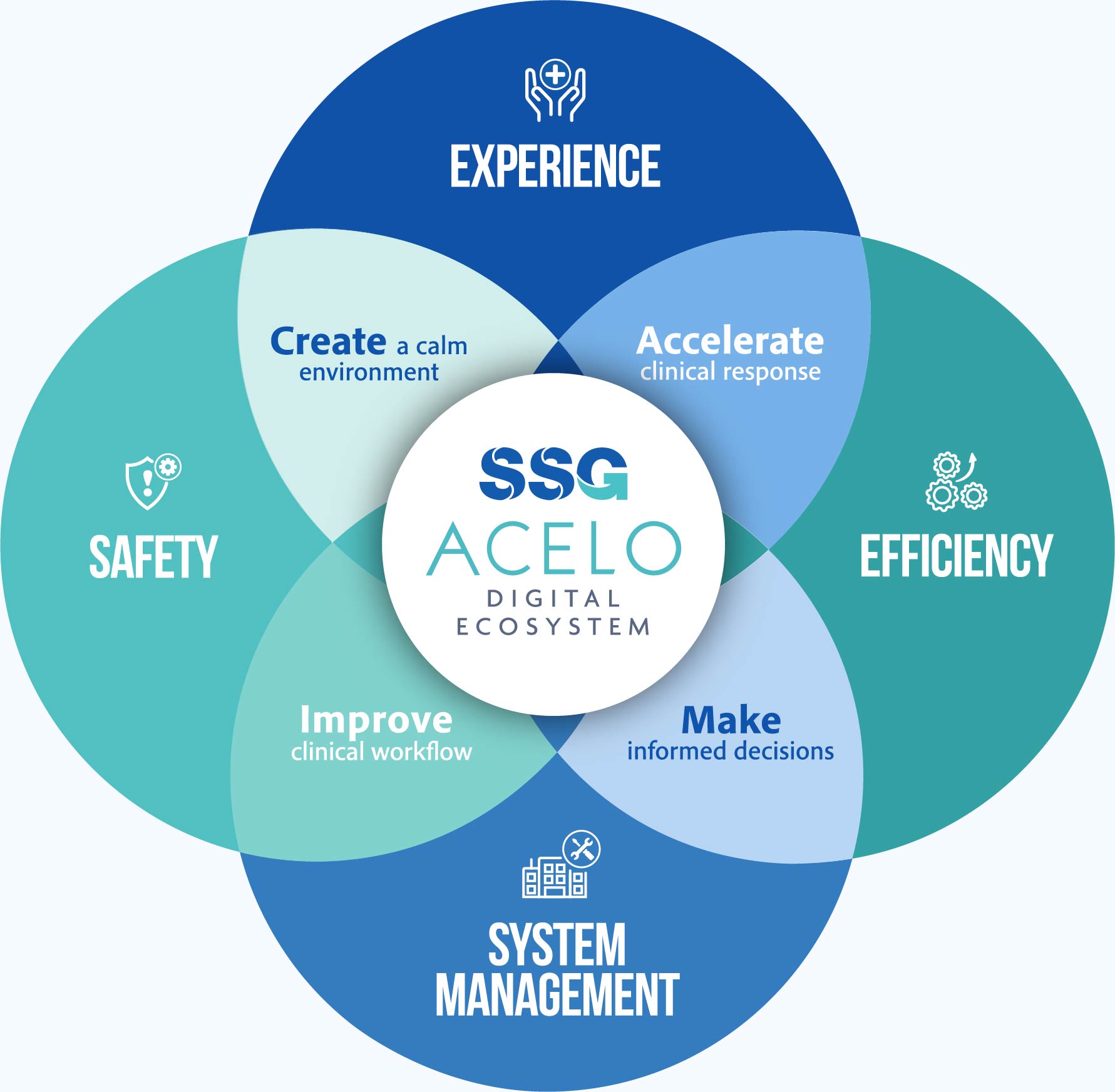
Many hospitals are still operating Nurse Call Systems that were never designed to meet today’s digital demands. However, we deliver a reliable, compliant Nurse Call System foundation with the capability to improve Safety, Efficiency, Experience, and System management, at a pace that works for your hospital.
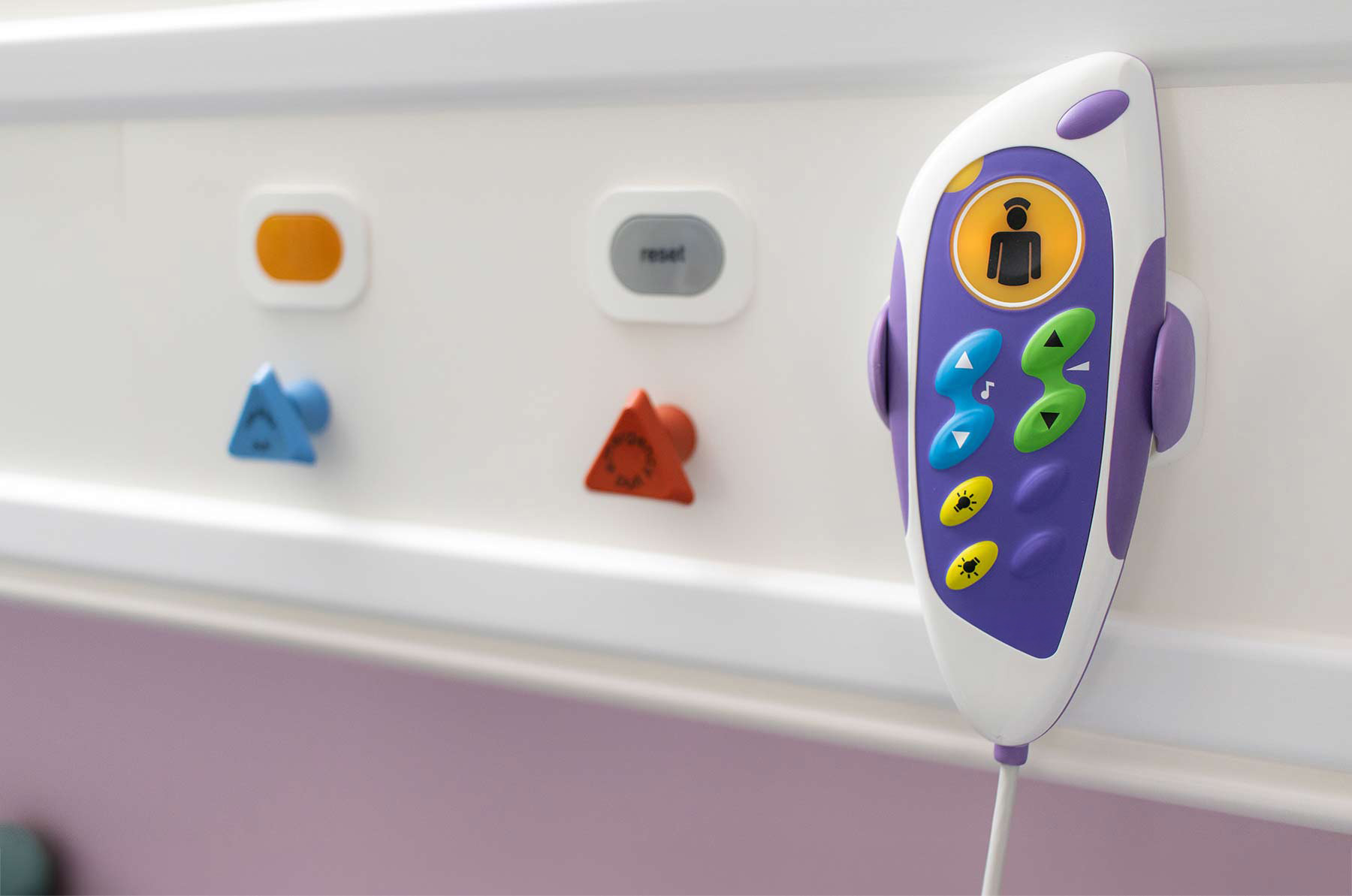
Digital Nurse Call Ecosystem
Legacy nurse call systems weren’t built for modern hospitals
Healthcare is changing.
Today’s hospitals face growing pressures, including increasing patient demand, staff shortages, and digital transformation.
Nurse call systems need to change
Traditional Nurse Call Systems were designed to do one thing: alert staff that an action is needed, with limited integration or connection to the wider ward environment. For decades, that was enough.
But the demands on modern hospitals have moved on.
Alarm fatigue
The large number of alarms means the alerts that matter get buried among those that don’t. With up to 75% of alarms requiring no clinical intervention, staff become desensitised and clinically significant alerts get missed.¹
Inefficient response
Staff walk to every call before they can assess what a patient needs, adding unnecessary time, steps, and stress. On an average shift, a nurse walks 5 miles, mostly responding to calls that could have been handled remotely.²
Reduced visibility
Single-room layouts mean patients are less visible than in traditional open bays. Without real-time visibility and insight across the ward, staff rely on physical checks to know what’s happening with each patient.
Meeting the expectations of hospital 2.0
Hospital 2.0 sets out the NHS vision for the next generation of digitally mature hospitals, where communication systems, clinical infrastructure, and patient data work together through seamless integration.
With single patient rooms central to that vision, closing the visibility gap in patient care is more important than ever, and silent wards become a clinical priority. Our Digital Nurse Call Ecosystem is designed to meet those expectations, with a reliable Nurse Call foundation and the digital capability to grow across safety, experience, and efficiency as hospitals transform.
4 Key Principles
01
Transformational patient care
Driving transformation to provide and excellent, safe and digitally enabled experience for patients visitors and staff.
02
Hospitals for now and the future
Hospitals that are adaptable and resilient to change, that transform national standards and leave a sustainable legacy.
03
Optimised healthcare structure
The right estate, the right layout, enabling people to be in the right place, supported by intelligent digital systems.
04
Built efficiently: operated and maintained to last
Using innovation and technology to leverage scale, and drive efficiency and value for money and ensure maximum durability for the future.
Acelo digital ecosystem
ACELO, the next-generation Digital Nurse Call Ecosystem. Securely logging and communicating data from across your ward, ACELO routes the right information to the right person, at the right time.
If what you need today is a fully HTM-compliant Nurse Call System, start with ACELO Call and add digital capability when the time is right.
ACELO’s growing network of interconnected capabilities works together through one connected platform:
For customers outside the UK, visit our international page
Is a wired or wireless SSG Nurse Call System
right for you?
The right foundation depends on your environment.
Nurse Call systems come in two main types: wired systems and wireless systems. Both have their advantages, and the right choice depends on your specific circumstances.
As SSG offer both, take this short survey to help you identify whether a wired or wireless SSG Nurse Call system is the best fit for your needs, both compliant with regulations and requirements.
Ultima
(Full-IP HTM 08-03)
Ultima is our current, proven, end-to-end IP-to-bed Nurse Call system, built to HTM-0803 standards.
Ultima is available for new installations and remains fully supported for hospitals already running the system, with continued servicing and upgrades available.
Wireless
(Wireless HTM 08-03)
Our fully wireless Nurse Call solution is designed for environments where a wired installation is not possible, not appropriate, or where a temporary solution is required.
Ready to future-proof your hospital?
01
Get in touch
Tell us about your hospital, your priorities, and the outcomes that matter most.
02
Configure ACELO
Map ACELO’s capabilities to your clinical and operational needs, building an ecosystem that’s right for your environment.
03
Deploy and embed
Introduce the system in phases, supporting adoption across teams without destabilising essential infrastructure.
Case studies
Hospitals rarely have the luxury of empty wards or decant space. Systems must evolve within live clinical environments where care continues every day. SSG provides an end-to-end service all within live clinical settings. Capability can be introduced in phases, supporting adoption across large organisations without destabilising essential infrastructure.
Read more about this in our case studies below.

SSG completes integrated safety and communication fit-out for Stepping Hill’s new Emergency and Urgent Care Campus
SSG completes integrated safety and communication fit-out for Stepping Hill’s new Emergency and Urgent Care Campus
Read More
SSG enhances patient safety and operational efficiency at Poole Hospital’s Community Diagnostic Centres Endoscopy Unit
SSG enhances patient safety and operational efficiency at Poole Hospital’s Community Diagnostic Centres Endoscopy Unit
Read More
SSG modernises patient communication with dual-site Nurse Call upgrade
SSG modernises patient communication with dual-site Nurse Call upgrade
Read More
SSG delivers full IP Nurse Call upgrade at Royal Hospital Oman
SSG delivers full IP Nurse Call upgrade at Royal Hospital Oman
Read More
SSG scales digital infrastructure for Oriel, the new world-class centre for Moorfields Eye Hospital
SSG scales digital infrastructure for Oriel, the new world-class centre for Moorfields Eye Hospital
Read More
SSG’s cutting-edge critical alarm systems chosen for The Midland Metropolitan University Hospital
SSG’s cutting-edge critical alarm systems chosen for The Midland Metropolitan University Hospital
Read MoreOur Digital Partners




Frequently asked questions
How does ACELO differ from a traditional Nurse Call System?
Traditional Nurse Call Systems do one thing: alert staff that an action is needed. ACELO does much more. By uniting Nurse Call with interconnected capabilities, ACELO delivers measurable improvements across Safety, Experience, Efficiency, and System management, in a single, connected platform.
What's the difference between ACELO and SSG's other Nurse Call Systems?
All of SSG’s Nurse Call Systems are built to HTM 08-03 standards and provide a reliable, compliant foundation for patient-to-staff communication. ACELO is designed as a digital ecosystem, with a next-generation Nurse Call System (ACELO Call) at its core and interconnected capabilities built around it.
If you’re not yet sure which Nurse Call System is right for your environment, take our short survey to find the best fit, then explore how the ecosystem can build around it.
Can ACELO integrate with our existing systems and infrastructure?
Yes, ACELO is designed to work within your existing clinical and digital environment. Its open architecture supports integration with a wide range of medical devices, mobile platforms, and hospital systems, making it suitable for both new build projects and phased upgrades to existing facilities.
Which Digital Nurse Call System is best for NHS trusts?
SSG is a leading UK manufacturer of Digital Nurse Call systems for NHS trusts, with decades of experience delivering HTM 08-03 compliant solutions across healthcare settings. Our systems are designed to grow with your organisation, introducing digital capability across safety, efficiency, experience, and system management at a pace that works for you.
Does our old Nurse Call System meet current compliance standards?
HTM 08-03 is the current guidance for Nurse Call Systems in UK healthcare settings. Whether your existing system meets it depends on the specific system and how it has been maintained and updated over time. At SSG, we can assess your current infrastructure and advise on the most practical path to full compliance, including phased replacement options that avoid disruption to live wards.
How long does a Digital Nurse Call installation take?
Installation timescales vary depending on the size and complexity of the environment. At SSG, we install within live clinical settings, meaning wards remain operational throughout. There is no requirement to close or vacate. A phased approach can be used for larger projects, which is beneficial in reducing risk, minimising disruption, and allowing healthcare facilities to continue operating safely during the upgrade. Training is also taken into account regarding how the overall installation will go.
How do I ensure a new Nurse Call System is compatible with existing healthcare IT?
SSG’s Digital Nurse Call Systems are designed to integrate with the wider hospital digital ecosystem, including electronic patient records (EPRs), staff communication devices such as Zebra handsets, and real-time location systems. Integration is structured to support Hospital 2.0 requirements, where communication systems and clinical infrastructure work together seamlessly.
What training do staff need when a new Nurse Call System is installed?
Every SSG installation provides handover staff training to ensure the department is fully up to speed with its new Digital Nurse Call System. More in-depth specialist training sessions are available as an add-on, tailored to the needs of your team and environment. Please contact your Account Managers to discuss your requirements.
How do I manage compatibility between a new Nurse Call System and existing hospital IT infrastructure?
Working closely with your IT and estates teams during the consultation phase, SSG maps existing infrastructure and identifies integration requirements before installation begins. Our systems are designed to work within complex hospital IT environments, and our end-to-end service means compatibility is assessed and managed by us throughout the project.
Should we integrate Bedhead Services with Nurse Call?
Integrating a Digital Nurse Call System with Bedhead Services Trunking creates a coordinated patient bed space where communication, power, medical gas, and data are all delivered through a single, managed infrastructure. This supports compliance, faster installation and improves overall patient safety. SSG designs and manufactures both systems, meaning integration is engineered from the start.
Where existing trunking is already in place, whether SSG’s own or another manufacturer’s, our team assesses compatibility during the consultation phase to determine the best integration approach.
What can a Digital Nurse Call System do that a traditional system cannot?
Traditional Nurse Call Systems alert staff when an action is needed. A Digital Nurse Call System goes further, integrating with a wide range of hospital systems, including medical devices, staff devices, EPRs, real-time location, and fall prevention technology, to give clinical teams real-time visibility across the ward. This supports improved patient reassurance, safety, and care through faster response times, better staff coordination, reduced noise through silent alerting, and data can be used to drive continuous improvement in care delivery. The breadth of integration depends on your priorities and can be introduced in phases as your digital maturity grows.
*1 – Healthcare Design & Management. Addressing alarm fatigue
*2 – Welton JM, Decker M, Adam J, Zone-Smith L. How far do nurses walk?. Medsurg Nurs. 2006;15(4):213-216

